

In June 2012, a jury in Oakland, California ordered Watchtower to pay $28 million for its role in the abuse of Candace Conti.*
In October 2014, a San Diego Superior Court judge ordered Watchtower to pay $13.5 million in punitive and compensatory damages for the abuse of Jose Lopez.
In June 2015, Watchtower was ordered to pay £275,000 to a victim of child abuse by the High Court in London.
*The amount and judgment were later reduced on appeal, with Watchtower still being required to pay $2.8 million in compensatory damages.
These are not isolated instances. They are not just the work of one or two rogue individuals. They are not persecution by Satan or the product of unjustified attacks by opposers. They are the result of specific, documented instructions issued to congregation elders by Watchtower on how child abuse should be handled.
This is a systemic problem, and sadly it will not be going away any time soon.
The reason why Candace Conti, Jose Lopez, and countless other children of Jehovah’s Witnesses have been let down is because the Governing Body views child sex abuse as a sin first-and-foremost, and only a crime by coincidence.
The “two witness rule,” according to which elders still operate today, means that they are to “leave matters in Jehovah’s hands” if an independent witness to an act of child molestation is not forthcoming. (see page 72 of the elders’ Shepherd manual, below)
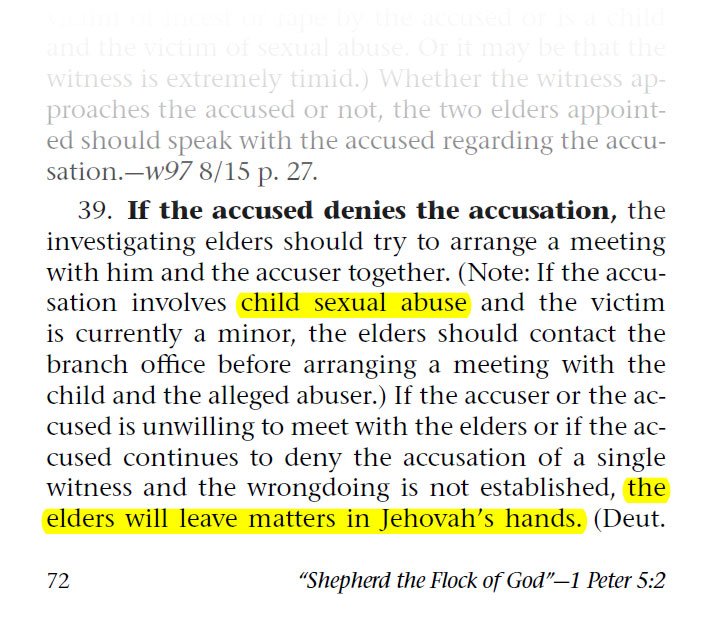 When critics of Jehovah’s Witnesses talk about the organization “protecting” pedophiles, they do not mean that the organization’s literature condones or encourages child molestation. They are referring to the fact that Watchtower policies effectively conceal pedophiles and make it easier for them to operate due to the culture of secrecy and confidentiality that Watchtower insists upon.
In the following video, investigative reporter Trey Bundy explains some of the disturbing lengths Watchtower has gone to in order to keep the identity of child molesters secret.
All of this means that you have no way of knowing whether someone in your congregation is a child molester or not, because the Governing Body is more interested in protecting the reputation of the organization than protecting ordinary children.
All they need to do to change things, and safeguard against more child abuse cases in the future, is write a letter to elders telling them to report ALL accusations of child abuse to the authorities – but the Governing Body absolutely refuses to do this.
If you are a Jehovah’s Witness reading this, you need to ask yourself: How can this be Jehovah’s Organization if it continues to put children at risk despite these adverse court judgments? If Jehovah’s clean organization truly abhors child abuse and considers it a crime, why can’t it allow all accusations of child abuse to be reported in the same way as other crimes (such as theft and murder) are to be reported?
The makers of this web page urge you to consider waking up to the possibility that only by confronting these issues and saying “enough is enough” can we bring about change and safeguard children of Jehovah’s Witnesses from those who would do them unspeakable harm.
We invite you to start doing research using some of the online resources listed below. And please don’t be afraid! Remember that if a God of love and truth really exists, he would never resent someone for trying to uncover the facts.
Narwhals may be using their tusks to play, new study finds
лаки джет играть
Scientists say they have the first recorded video evidence of narwhals using tusks not only to strike and manipulate fish during feeding but also engage in what appears to be playful behavior, according to the latest research.
The narwhal, often referred to as the “unicorn of the sea” in a nod to its trademark tusk, has long remained an enigma. Scientists have observed few interactions of narwhals in their natural habitat, creating speculation about the purpose of the species’ distinctive spiraling tusk.
https://lucky-jetts.com
lucky jet игра
Found predominantly in males, the tusk grows up to 10 feet (3 meters) long — and previous research has suggested it serves as a competitive display to secure mates. But now, with the help of drones, research conducted in the Canadian High Arctic has uncovered that a narwhal may use its tusk for more than just courtship.
In total, the researchers newly identified and described 17 distinct behaviors of narwhals involving prey. The findings revealed a wide range of interactions and dynamics between narwhals and fish as well as the extraordinary agility, precision and speed of their tusks to track moving targets, according to the study published February 27 in the journal Frontiers in Marine Science.
“Seeing that these animals are not actually hunting the fish but exploring, manipulating and interacting with it was really a game changer,” said lead author Dr. Gregory O’Corry-Crowe, a research professor in the Harbor Branch Oceanographic Institute at Florida Atlantic University.
Since so little is understood about this whale species, researchers like O’Corry-Crowe and his colleagues are working diligently to conduct studies to document narwhals’ unknown behaviors to better understand how these animals adapt in a rapidly shifting habitat as oceans warm and sea ice melts.
Narwhal exploratory behavior
The study team captured the groundbreaking footage using drones in Creswell Bay, on the eastern side of Somerset Island in Canada’s Nunavut territory, during the summer of 2022.
As the researchers analyzed the footage, they noticed subtle nuances in the narwhals’ behavior. Footage even captured one instance of a narwhal interacting with a fish by repeatedly nudging it with its tusk — which is actually a giant tooth — without attempting to eat it.
When researchers observed a lack of aggression in some interactions between narwhals and fish, they realized these scenarios were more similar to a cat-and-mouse game, in which the animals were chasing or “playing” rather than hunting, O’Corry-Crowe said.
DOGE attempts to enter an agency building led to physical standoff that spilled into court
кракен онион
A small federal agency that sends money to help communities in Africa became a flashpoint Thursday in the Trump administration’s efforts to shut down foreign aid and reduce the size of the federal government.
A Trump-backed government official, staffers from the Department of Government Efficiency and federal law enforcement entered the offices of the U.S. African Development Foundation on Thursday, and the fight between the Senate-confirmed foundation’s board and Trump administration emissaries spilled into an emergency court fight, according to court records and photos of the in-person standoff captured by the New York Times.
https://kra28c.cc
kra29 cc
The standoff was quelled when a judge stepped in Thursday afternoon, keeping the foundation’s existing board in place for a few days until a court hearing could take place.
The African Development Foundation, an independent agency that has provided more than $100 million to African farmers, entrepreneurs and community organizations in the last five years, has been among the foreign aid groups that Trump has targeted to eliminate via an executive order he issued two weeks ago. The work of DOGE at the agency so far, the lawsuit says, mirrors how other foreign aid agencies have been dismantled by the Trump administration.
Trump’s plan for the African Development Foundation snapped into action almost immediately, with DOGE staffers meeting with the foundation’s leadership within days of Trump’s February 21 executive order. The Trump administration then told a board member, Ward Brehm, he was being removed from his position, and a new acting chair would be in charge.
Faced with the overhaul, the board held an emergency meeting on Monday to push back, according to a lawsuit filed in federal court in Washington this week. The board decided Trump’s appointee, Peter Marocco — the de-facto acting leader of USAID, another agency Trump has targeted — was not lawfully in the job, and they alerted Congress, the removed board member Ward Brehm’s lawsuit said.
Marocco still showed up at the fund’s headquarters with staffers of the Department of Government Efficiency on Wednesday afternoon. They “were denied access to those offices,” the lawsuit said. “Marocco and his colleagues threatened to return to the offices with United States Marshals and Secret Service.”
посетить веб-сайт мега сайт
пояснения mega зеркала
Следующая страница мега даркнет
выберите ресурсы мега мориарти
DOGE attempts to enter an agency building led to physical standoff that spilled into court
kraken тор
A small federal agency that sends money to help communities in Africa became a flashpoint Thursday in the Trump administration’s efforts to shut down foreign aid and reduce the size of the federal government.
A Trump-backed government official, staffers from the Department of Government Efficiency and federal law enforcement entered the offices of the U.S. African Development Foundation on Thursday, and the fight between the Senate-confirmed foundation’s board and Trump administration emissaries spilled into an emergency court fight, according to court records and photos of the in-person standoff captured by the New York Times.
https://kra28c.cc
кракен даркнет
The standoff was quelled when a judge stepped in Thursday afternoon, keeping the foundation’s existing board in place for a few days until a court hearing could take place.
The African Development Foundation, an independent agency that has provided more than $100 million to African farmers, entrepreneurs and community organizations in the last five years, has been among the foreign aid groups that Trump has targeted to eliminate via an executive order he issued two weeks ago. The work of DOGE at the agency so far, the lawsuit says, mirrors how other foreign aid agencies have been dismantled by the Trump administration.
Trump’s plan for the African Development Foundation snapped into action almost immediately, with DOGE staffers meeting with the foundation’s leadership within days of Trump’s February 21 executive order. The Trump administration then told a board member, Ward Brehm, he was being removed from his position, and a new acting chair would be in charge.
Faced with the overhaul, the board held an emergency meeting on Monday to push back, according to a lawsuit filed in federal court in Washington this week. The board decided Trump’s appointee, Peter Marocco — the de-facto acting leader of USAID, another agency Trump has targeted — was not lawfully in the job, and they alerted Congress, the removed board member Ward Brehm’s lawsuit said.
Marocco still showed up at the fund’s headquarters with staffers of the Department of Government Efficiency on Wednesday afternoon. They “were denied access to those offices,” the lawsuit said. “Marocco and his colleagues threatened to return to the offices with United States Marshals and Secret Service.”
Продолжение мега ссылка
Narwhals may be using their tusks to play, new study finds
lucky jet
Scientists say they have the first recorded video evidence of narwhals using tusks not only to strike and manipulate fish during feeding but also engage in what appears to be playful behavior, according to the latest research.
The narwhal, often referred to as the “unicorn of the sea” in a nod to its trademark tusk, has long remained an enigma. Scientists have observed few interactions of narwhals in their natural habitat, creating speculation about the purpose of the species’ distinctive spiraling tusk.
https://lucky-jetts.com
lucky jet играть
Found predominantly in males, the tusk grows up to 10 feet (3 meters) long — and previous research has suggested it serves as a competitive display to secure mates. But now, with the help of drones, research conducted in the Canadian High Arctic has uncovered that a narwhal may use its tusk for more than just courtship.
In total, the researchers newly identified and described 17 distinct behaviors of narwhals involving prey. The findings revealed a wide range of interactions and dynamics between narwhals and fish as well as the extraordinary agility, precision and speed of their tusks to track moving targets, according to the study published February 27 in the journal Frontiers in Marine Science.
“Seeing that these animals are not actually hunting the fish but exploring, manipulating and interacting with it was really a game changer,” said lead author Dr. Gregory O’Corry-Crowe, a research professor in the Harbor Branch Oceanographic Institute at Florida Atlantic University.
Since so little is understood about this whale species, researchers like O’Corry-Crowe and his colleagues are working diligently to conduct studies to document narwhals’ unknown behaviors to better understand how these animals adapt in a rapidly shifting habitat as oceans warm and sea ice melts.
Narwhal exploratory behavior
The study team captured the groundbreaking footage using drones in Creswell Bay, on the eastern side of Somerset Island in Canada’s Nunavut territory, during the summer of 2022.
As the researchers analyzed the footage, they noticed subtle nuances in the narwhals’ behavior. Footage even captured one instance of a narwhal interacting with a fish by repeatedly nudging it with its tusk — which is actually a giant tooth — without attempting to eat it.
When researchers observed a lack of aggression in some interactions between narwhals and fish, they realized these scenarios were more similar to a cat-and-mouse game, in which the animals were chasing or “playing” rather than hunting, O’Corry-Crowe said.
ссылка на сайт мега мориарти
Narwhals may be using their tusks to play, new study finds
сигналы лаки джет
Scientists say they have the first recorded video evidence of narwhals using tusks not only to strike and manipulate fish during feeding but also engage in what appears to be playful behavior, according to the latest research.
The narwhal, often referred to as the “unicorn of the sea” in a nod to its trademark tusk, has long remained an enigma. Scientists have observed few interactions of narwhals in their natural habitat, creating speculation about the purpose of the species’ distinctive spiraling tusk.
https://lucky-jetts.com
lucky jet
Found predominantly in males, the tusk grows up to 10 feet (3 meters) long — and previous research has suggested it serves as a competitive display to secure mates. But now, with the help of drones, research conducted in the Canadian High Arctic has uncovered that a narwhal may use its tusk for more than just courtship.
In total, the researchers newly identified and described 17 distinct behaviors of narwhals involving prey. The findings revealed a wide range of interactions and dynamics between narwhals and fish as well as the extraordinary agility, precision and speed of their tusks to track moving targets, according to the study published February 27 in the journal Frontiers in Marine Science.
“Seeing that these animals are not actually hunting the fish but exploring, manipulating and interacting with it was really a game changer,” said lead author Dr. Gregory O’Corry-Crowe, a research professor in the Harbor Branch Oceanographic Institute at Florida Atlantic University.
Since so little is understood about this whale species, researchers like O’Corry-Crowe and his colleagues are working diligently to conduct studies to document narwhals’ unknown behaviors to better understand how these animals adapt in a rapidly shifting habitat as oceans warm and sea ice melts.
Narwhal exploratory behavior
The study team captured the groundbreaking footage using drones in Creswell Bay, on the eastern side of Somerset Island in Canada’s Nunavut territory, during the summer of 2022.
As the researchers analyzed the footage, they noticed subtle nuances in the narwhals’ behavior. Footage even captured one instance of a narwhal interacting with a fish by repeatedly nudging it with its tusk — which is actually a giant tooth — without attempting to eat it.
When researchers observed a lack of aggression in some interactions between narwhals and fish, they realized these scenarios were more similar to a cat-and-mouse game, in which the animals were chasing or “playing” rather than hunting, O’Corry-Crowe said.
продолжить мега даркнет
узнать больше Здесь магазин мега мориарти
DOGE attempts to enter an agency building led to physical standoff that spilled into court
Кракен тор
A small federal agency that sends money to help communities in Africa became a flashpoint Thursday in the Trump administration’s efforts to shut down foreign aid and reduce the size of the federal government.
A Trump-backed government official, staffers from the Department of Government Efficiency and federal law enforcement entered the offices of the U.S. African Development Foundation on Thursday, and the fight between the Senate-confirmed foundation’s board and Trump administration emissaries spilled into an emergency court fight, according to court records and photos of the in-person standoff captured by the New York Times.
https://kra28c.cc
kraken магазин
The standoff was quelled when a judge stepped in Thursday afternoon, keeping the foundation’s existing board in place for a few days until a court hearing could take place.
The African Development Foundation, an independent agency that has provided more than $100 million to African farmers, entrepreneurs and community organizations in the last five years, has been among the foreign aid groups that Trump has targeted to eliminate via an executive order he issued two weeks ago. The work of DOGE at the agency so far, the lawsuit says, mirrors how other foreign aid agencies have been dismantled by the Trump administration.
Trump’s plan for the African Development Foundation snapped into action almost immediately, with DOGE staffers meeting with the foundation’s leadership within days of Trump’s February 21 executive order. The Trump administration then told a board member, Ward Brehm, he was being removed from his position, and a new acting chair would be in charge.
Faced with the overhaul, the board held an emergency meeting on Monday to push back, according to a lawsuit filed in federal court in Washington this week. The board decided Trump’s appointee, Peter Marocco — the de-facto acting leader of USAID, another agency Trump has targeted — was not lawfully in the job, and they alerted Congress, the removed board member Ward Brehm’s lawsuit said.
Marocco still showed up at the fund’s headquarters with staffers of the Department of Government Efficiency on Wednesday afternoon. They “were denied access to those offices,” the lawsuit said. “Marocco and his colleagues threatened to return to the offices with United States Marshals and Secret Service.”
DOGE attempts to enter an agency building led to physical standoff that spilled into court
kraken магазин
A small federal agency that sends money to help communities in Africa became a flashpoint Thursday in the Trump administration’s efforts to shut down foreign aid and reduce the size of the federal government.
A Trump-backed government official, staffers from the Department of Government Efficiency and federal law enforcement entered the offices of the U.S. African Development Foundation on Thursday, and the fight between the Senate-confirmed foundation’s board and Trump administration emissaries spilled into an emergency court fight, according to court records and photos of the in-person standoff captured by the New York Times.
https://kra28c.cc
Кракен даркнет
The standoff was quelled when a judge stepped in Thursday afternoon, keeping the foundation’s existing board in place for a few days until a court hearing could take place.
The African Development Foundation, an independent agency that has provided more than $100 million to African farmers, entrepreneurs and community organizations in the last five years, has been among the foreign aid groups that Trump has targeted to eliminate via an executive order he issued two weeks ago. The work of DOGE at the agency so far, the lawsuit says, mirrors how other foreign aid agencies have been dismantled by the Trump administration.
Trump’s plan for the African Development Foundation snapped into action almost immediately, with DOGE staffers meeting with the foundation’s leadership within days of Trump’s February 21 executive order. The Trump administration then told a board member, Ward Brehm, he was being removed from his position, and a new acting chair would be in charge.
Faced with the overhaul, the board held an emergency meeting on Monday to push back, according to a lawsuit filed in federal court in Washington this week. The board decided Trump’s appointee, Peter Marocco — the de-facto acting leader of USAID, another agency Trump has targeted — was not lawfully in the job, and they alerted Congress, the removed board member Ward Brehm’s lawsuit said.
Marocco still showed up at the fund’s headquarters with staffers of the Department of Government Efficiency on Wednesday afternoon. They “were denied access to those offices,” the lawsuit said. “Marocco and his colleagues threatened to return to the offices with United States Marshals and Secret Service.”
Следующая страница mega мориарти
Подробнее мега ссылка
посмотреть на этом сайте мега даркнет
Narwhals may be using their tusks to play, new study finds
лаки джет
Scientists say they have the first recorded video evidence of narwhals using tusks not only to strike and manipulate fish during feeding but also engage in what appears to be playful behavior, according to the latest research.
The narwhal, often referred to as the “unicorn of the sea” in a nod to its trademark tusk, has long remained an enigma. Scientists have observed few interactions of narwhals in their natural habitat, creating speculation about the purpose of the species’ distinctive spiraling tusk.
https://lucky-jetts.com
lucky jet играть
Found predominantly in males, the tusk grows up to 10 feet (3 meters) long — and previous research has suggested it serves as a competitive display to secure mates. But now, with the help of drones, research conducted in the Canadian High Arctic has uncovered that a narwhal may use its tusk for more than just courtship.
In total, the researchers newly identified and described 17 distinct behaviors of narwhals involving prey. The findings revealed a wide range of interactions and dynamics between narwhals and fish as well as the extraordinary agility, precision and speed of their tusks to track moving targets, according to the study published February 27 in the journal Frontiers in Marine Science.
“Seeing that these animals are not actually hunting the fish but exploring, manipulating and interacting with it was really a game changer,” said lead author Dr. Gregory O’Corry-Crowe, a research professor in the Harbor Branch Oceanographic Institute at Florida Atlantic University.
Since so little is understood about this whale species, researchers like O’Corry-Crowe and his colleagues are working diligently to conduct studies to document narwhals’ unknown behaviors to better understand how these animals adapt in a rapidly shifting habitat as oceans warm and sea ice melts.
Narwhal exploratory behavior
The study team captured the groundbreaking footage using drones in Creswell Bay, on the eastern side of Somerset Island in Canada’s Nunavut territory, during the summer of 2022.
As the researchers analyzed the footage, they noticed subtle nuances in the narwhals’ behavior. Footage even captured one instance of a narwhal interacting with a fish by repeatedly nudging it with its tusk — which is actually a giant tooth — without attempting to eat it.
When researchers observed a lack of aggression in some interactions between narwhals and fish, they realized these scenarios were more similar to a cat-and-mouse game, in which the animals were chasing or “playing” rather than hunting, O’Corry-Crowe said.
такой mega зеркала
Narwhals may be using their tusks to play, new study finds
лаки джет официальный сайт
Scientists say they have the first recorded video evidence of narwhals using tusks not only to strike and manipulate fish during feeding but also engage in what appears to be playful behavior, according to the latest research.
The narwhal, often referred to as the “unicorn of the sea” in a nod to its trademark tusk, has long remained an enigma. Scientists have observed few interactions of narwhals in their natural habitat, creating speculation about the purpose of the species’ distinctive spiraling tusk.
https://lucky-jetts.com
лаки джет играть
Found predominantly in males, the tusk grows up to 10 feet (3 meters) long — and previous research has suggested it serves as a competitive display to secure mates. But now, with the help of drones, research conducted in the Canadian High Arctic has uncovered that a narwhal may use its tusk for more than just courtship.
In total, the researchers newly identified and described 17 distinct behaviors of narwhals involving prey. The findings revealed a wide range of interactions and dynamics between narwhals and fish as well as the extraordinary agility, precision and speed of their tusks to track moving targets, according to the study published February 27 in the journal Frontiers in Marine Science.
“Seeing that these animals are not actually hunting the fish but exploring, manipulating and interacting with it was really a game changer,” said lead author Dr. Gregory O’Corry-Crowe, a research professor in the Harbor Branch Oceanographic Institute at Florida Atlantic University.
Since so little is understood about this whale species, researchers like O’Corry-Crowe and his colleagues are working diligently to conduct studies to document narwhals’ unknown behaviors to better understand how these animals adapt in a rapidly shifting habitat as oceans warm and sea ice melts.
Narwhal exploratory behavior
The study team captured the groundbreaking footage using drones in Creswell Bay, on the eastern side of Somerset Island in Canada’s Nunavut territory, during the summer of 2022.
As the researchers analyzed the footage, they noticed subtle nuances in the narwhals’ behavior. Footage even captured one instance of a narwhal interacting with a fish by repeatedly nudging it with its tusk — which is actually a giant tooth — without attempting to eat it.
When researchers observed a lack of aggression in some interactions between narwhals and fish, they realized these scenarios were more similar to a cat-and-mouse game, in which the animals were chasing or “playing” rather than hunting, O’Corry-Crowe said.
этот контент магазин мега мориарти
DOGE attempts to enter an agency building led to physical standoff that spilled into court
kraken войти
A small federal agency that sends money to help communities in Africa became a flashpoint Thursday in the Trump administration’s efforts to shut down foreign aid and reduce the size of the federal government.
A Trump-backed government official, staffers from the Department of Government Efficiency and federal law enforcement entered the offices of the U.S. African Development Foundation on Thursday, and the fight between the Senate-confirmed foundation’s board and Trump administration emissaries spilled into an emergency court fight, according to court records and photos of the in-person standoff captured by the New York Times.
https://kra28c.cc
kraken marketplace
The standoff was quelled when a judge stepped in Thursday afternoon, keeping the foundation’s existing board in place for a few days until a court hearing could take place.
The African Development Foundation, an independent agency that has provided more than $100 million to African farmers, entrepreneurs and community organizations in the last five years, has been among the foreign aid groups that Trump has targeted to eliminate via an executive order he issued two weeks ago. The work of DOGE at the agency so far, the lawsuit says, mirrors how other foreign aid agencies have been dismantled by the Trump administration.
Trump’s plan for the African Development Foundation snapped into action almost immediately, with DOGE staffers meeting with the foundation’s leadership within days of Trump’s February 21 executive order. The Trump administration then told a board member, Ward Brehm, he was being removed from his position, and a new acting chair would be in charge.
Faced with the overhaul, the board held an emergency meeting on Monday to push back, according to a lawsuit filed in federal court in Washington this week. The board decided Trump’s appointee, Peter Marocco — the de-facto acting leader of USAID, another agency Trump has targeted — was not lawfully in the job, and they alerted Congress, the removed board member Ward Brehm’s lawsuit said.
Marocco still showed up at the fund’s headquarters with staffers of the Department of Government Efficiency on Wednesday afternoon. They “were denied access to those offices,” the lawsuit said. “Marocco and his colleagues threatened to return to the offices with United States Marshals and Secret Service.”
DOGE attempts to enter an agency building led to physical standoff that spilled into court
кракен
A small federal agency that sends money to help communities in Africa became a flashpoint Thursday in the Trump administration’s efforts to shut down foreign aid and reduce the size of the federal government.
A Trump-backed government official, staffers from the Department of Government Efficiency and federal law enforcement entered the offices of the U.S. African Development Foundation on Thursday, and the fight between the Senate-confirmed foundation’s board and Trump administration emissaries spilled into an emergency court fight, according to court records and photos of the in-person standoff captured by the New York Times.
https://kra28c.cc
kraken ссылка
The standoff was quelled when a judge stepped in Thursday afternoon, keeping the foundation’s existing board in place for a few days until a court hearing could take place.
The African Development Foundation, an independent agency that has provided more than $100 million to African farmers, entrepreneurs and community organizations in the last five years, has been among the foreign aid groups that Trump has targeted to eliminate via an executive order he issued two weeks ago. The work of DOGE at the agency so far, the lawsuit says, mirrors how other foreign aid agencies have been dismantled by the Trump administration.
Trump’s plan for the African Development Foundation snapped into action almost immediately, with DOGE staffers meeting with the foundation’s leadership within days of Trump’s February 21 executive order. The Trump administration then told a board member, Ward Brehm, he was being removed from his position, and a new acting chair would be in charge.
Faced with the overhaul, the board held an emergency meeting on Monday to push back, according to a lawsuit filed in federal court in Washington this week. The board decided Trump’s appointee, Peter Marocco — the de-facto acting leader of USAID, another agency Trump has targeted — was not lawfully in the job, and they alerted Congress, the removed board member Ward Brehm’s lawsuit said.
Marocco still showed up at the fund’s headquarters with staffers of the Department of Government Efficiency on Wednesday afternoon. They “were denied access to those offices,” the lawsuit said. “Marocco and his colleagues threatened to return to the offices with United States Marshals and Secret Service.”
Narwhals may be using their tusks to play, new study finds
сайт lucky jet
Scientists say they have the first recorded video evidence of narwhals using tusks not only to strike and manipulate fish during feeding but also engage in what appears to be playful behavior, according to the latest research.
The narwhal, often referred to as the “unicorn of the sea” in a nod to its trademark tusk, has long remained an enigma. Scientists have observed few interactions of narwhals in their natural habitat, creating speculation about the purpose of the species’ distinctive spiraling tusk.
https://lucky-jetts.com
lucky jet игра
Found predominantly in males, the tusk grows up to 10 feet (3 meters) long — and previous research has suggested it serves as a competitive display to secure mates. But now, with the help of drones, research conducted in the Canadian High Arctic has uncovered that a narwhal may use its tusk for more than just courtship.
In total, the researchers newly identified and described 17 distinct behaviors of narwhals involving prey. The findings revealed a wide range of interactions and dynamics between narwhals and fish as well as the extraordinary agility, precision and speed of their tusks to track moving targets, according to the study published February 27 in the journal Frontiers in Marine Science.
“Seeing that these animals are not actually hunting the fish but exploring, manipulating and interacting with it was really a game changer,” said lead author Dr. Gregory O’Corry-Crowe, a research professor in the Harbor Branch Oceanographic Institute at Florida Atlantic University.
Since so little is understood about this whale species, researchers like O’Corry-Crowe and his colleagues are working diligently to conduct studies to document narwhals’ unknown behaviors to better understand how these animals adapt in a rapidly shifting habitat as oceans warm and sea ice melts.
Narwhal exploratory behavior
The study team captured the groundbreaking footage using drones in Creswell Bay, on the eastern side of Somerset Island in Canada’s Nunavut territory, during the summer of 2022.
As the researchers analyzed the footage, they noticed subtle nuances in the narwhals’ behavior. Footage even captured one instance of a narwhal interacting with a fish by repeatedly nudging it with its tusk — which is actually a giant tooth — without attempting to eat it.
When researchers observed a lack of aggression in some interactions between narwhals and fish, they realized these scenarios were more similar to a cat-and-mouse game, in which the animals were chasing or “playing” rather than hunting, O’Corry-Crowe said.
Narwhals may be using their tusks to play, new study finds
лаки джет сайт
Scientists say they have the first recorded video evidence of narwhals using tusks not only to strike and manipulate fish during feeding but also engage in what appears to be playful behavior, according to the latest research.
The narwhal, often referred to as the “unicorn of the sea” in a nod to its trademark tusk, has long remained an enigma. Scientists have observed few interactions of narwhals in their natural habitat, creating speculation about the purpose of the species’ distinctive spiraling tusk.
https://lucky-jetts.com
lucky jet сигналы
Found predominantly in males, the tusk grows up to 10 feet (3 meters) long — and previous research has suggested it serves as a competitive display to secure mates. But now, with the help of drones, research conducted in the Canadian High Arctic has uncovered that a narwhal may use its tusk for more than just courtship.
In total, the researchers newly identified and described 17 distinct behaviors of narwhals involving prey. The findings revealed a wide range of interactions and dynamics between narwhals and fish as well as the extraordinary agility, precision and speed of their tusks to track moving targets, according to the study published February 27 in the journal Frontiers in Marine Science.
“Seeing that these animals are not actually hunting the fish but exploring, manipulating and interacting with it was really a game changer,” said lead author Dr. Gregory O’Corry-Crowe, a research professor in the Harbor Branch Oceanographic Institute at Florida Atlantic University.
Since so little is understood about this whale species, researchers like O’Corry-Crowe and his colleagues are working diligently to conduct studies to document narwhals’ unknown behaviors to better understand how these animals adapt in a rapidly shifting habitat as oceans warm and sea ice melts.
Narwhal exploratory behavior
The study team captured the groundbreaking footage using drones in Creswell Bay, on the eastern side of Somerset Island in Canada’s Nunavut territory, during the summer of 2022.
As the researchers analyzed the footage, they noticed subtle nuances in the narwhals’ behavior. Footage even captured one instance of a narwhal interacting with a fish by repeatedly nudging it with its tusk — which is actually a giant tooth — without attempting to eat it.
When researchers observed a lack of aggression in some interactions between narwhals and fish, they realized these scenarios were more similar to a cat-and-mouse game, in which the animals were chasing or “playing” rather than hunting, O’Corry-Crowe said.
Narwhals may be using their tusks to play, new study finds
лаки джет играть
Scientists say they have the first recorded video evidence of narwhals using tusks not only to strike and manipulate fish during feeding but also engage in what appears to be playful behavior, according to the latest research.
The narwhal, often referred to as the “unicorn of the sea” in a nod to its trademark tusk, has long remained an enigma. Scientists have observed few interactions of narwhals in their natural habitat, creating speculation about the purpose of the species’ distinctive spiraling tusk.
https://lucky-jetts.com
сигналы лаки джет
Found predominantly in males, the tusk grows up to 10 feet (3 meters) long — and previous research has suggested it serves as a competitive display to secure mates. But now, with the help of drones, research conducted in the Canadian High Arctic has uncovered that a narwhal may use its tusk for more than just courtship.
In total, the researchers newly identified and described 17 distinct behaviors of narwhals involving prey. The findings revealed a wide range of interactions and dynamics between narwhals and fish as well as the extraordinary agility, precision and speed of their tusks to track moving targets, according to the study published February 27 in the journal Frontiers in Marine Science.
“Seeing that these animals are not actually hunting the fish but exploring, manipulating and interacting with it was really a game changer,” said lead author Dr. Gregory O’Corry-Crowe, a research professor in the Harbor Branch Oceanographic Institute at Florida Atlantic University.
Since so little is understood about this whale species, researchers like O’Corry-Crowe and his colleagues are working diligently to conduct studies to document narwhals’ unknown behaviors to better understand how these animals adapt in a rapidly shifting habitat as oceans warm and sea ice melts.
Narwhal exploratory behavior
The study team captured the groundbreaking footage using drones in Creswell Bay, on the eastern side of Somerset Island in Canada’s Nunavut territory, during the summer of 2022.
As the researchers analyzed the footage, they noticed subtle nuances in the narwhals’ behavior. Footage even captured one instance of a narwhal interacting with a fish by repeatedly nudging it with its tusk — which is actually a giant tooth — without attempting to eat it.
When researchers observed a lack of aggression in some interactions between narwhals and fish, they realized these scenarios were more similar to a cat-and-mouse game, in which the animals were chasing or “playing” rather than hunting, O’Corry-Crowe said.
продолжить мега даркнет
DOGE attempts to enter an agency building led to physical standoff that spilled into court
kraken tor
A small federal agency that sends money to help communities in Africa became a flashpoint Thursday in the Trump administration’s efforts to shut down foreign aid and reduce the size of the federal government.
A Trump-backed government official, staffers from the Department of Government Efficiency and federal law enforcement entered the offices of the U.S. African Development Foundation on Thursday, and the fight between the Senate-confirmed foundation’s board and Trump administration emissaries spilled into an emergency court fight, according to court records and photos of the in-person standoff captured by the New York Times.
https://kra28c.cc
Площадка кракен
The standoff was quelled when a judge stepped in Thursday afternoon, keeping the foundation’s existing board in place for a few days until a court hearing could take place.
The African Development Foundation, an independent agency that has provided more than $100 million to African farmers, entrepreneurs and community organizations in the last five years, has been among the foreign aid groups that Trump has targeted to eliminate via an executive order he issued two weeks ago. The work of DOGE at the agency so far, the lawsuit says, mirrors how other foreign aid agencies have been dismantled by the Trump administration.
Trump’s plan for the African Development Foundation snapped into action almost immediately, with DOGE staffers meeting with the foundation’s leadership within days of Trump’s February 21 executive order. The Trump administration then told a board member, Ward Brehm, he was being removed from his position, and a new acting chair would be in charge.
Faced with the overhaul, the board held an emergency meeting on Monday to push back, according to a lawsuit filed in federal court in Washington this week. The board decided Trump’s appointee, Peter Marocco — the de-facto acting leader of USAID, another agency Trump has targeted — was not lawfully in the job, and they alerted Congress, the removed board member Ward Brehm’s lawsuit said.
Marocco still showed up at the fund’s headquarters with staffers of the Department of Government Efficiency on Wednesday afternoon. They “were denied access to those offices,” the lawsuit said. “Marocco and his colleagues threatened to return to the offices with United States Marshals and Secret Service.”
kraken – кракен купить, kra32.cc
DOGE attempts to enter an agency building led to physical standoff that spilled into court
kraken ссылка
A small federal agency that sends money to help communities in Africa became a flashpoint Thursday in the Trump administration’s efforts to shut down foreign aid and reduce the size of the federal government.
A Trump-backed government official, staffers from the Department of Government Efficiency and federal law enforcement entered the offices of the U.S. African Development Foundation on Thursday, and the fight between the Senate-confirmed foundation’s board and Trump administration emissaries spilled into an emergency court fight, according to court records and photos of the in-person standoff captured by the New York Times.
https://kra28c.cc
кракен
The standoff was quelled when a judge stepped in Thursday afternoon, keeping the foundation’s existing board in place for a few days until a court hearing could take place.
The African Development Foundation, an independent agency that has provided more than $100 million to African farmers, entrepreneurs and community organizations in the last five years, has been among the foreign aid groups that Trump has targeted to eliminate via an executive order he issued two weeks ago. The work of DOGE at the agency so far, the lawsuit says, mirrors how other foreign aid agencies have been dismantled by the Trump administration.
Trump’s plan for the African Development Foundation snapped into action almost immediately, with DOGE staffers meeting with the foundation’s leadership within days of Trump’s February 21 executive order. The Trump administration then told a board member, Ward Brehm, he was being removed from his position, and a new acting chair would be in charge.
Faced with the overhaul, the board held an emergency meeting on Monday to push back, according to a lawsuit filed in federal court in Washington this week. The board decided Trump’s appointee, Peter Marocco — the de-facto acting leader of USAID, another agency Trump has targeted — was not lawfully in the job, and they alerted Congress, the removed board member Ward Brehm’s lawsuit said.
Marocco still showed up at the fund’s headquarters with staffers of the Department of Government Efficiency on Wednesday afternoon. They “were denied access to those offices,” the lawsuit said. “Marocco and his colleagues threatened to return to the offices with United States Marshals and Secret Service.”
Narwhals may be using their tusks to play, new study finds
lucky jet на деньги
Scientists say they have the first recorded video evidence of narwhals using tusks not only to strike and manipulate fish during feeding but also engage in what appears to be playful behavior, according to the latest research.
The narwhal, often referred to as the “unicorn of the sea” in a nod to its trademark tusk, has long remained an enigma. Scientists have observed few interactions of narwhals in their natural habitat, creating speculation about the purpose of the species’ distinctive spiraling tusk.
https://lucky-jetts.com
lucky jet сигналы
Found predominantly in males, the tusk grows up to 10 feet (3 meters) long — and previous research has suggested it serves as a competitive display to secure mates. But now, with the help of drones, research conducted in the Canadian High Arctic has uncovered that a narwhal may use its tusk for more than just courtship.
In total, the researchers newly identified and described 17 distinct behaviors of narwhals involving prey. The findings revealed a wide range of interactions and dynamics between narwhals and fish as well as the extraordinary agility, precision and speed of their tusks to track moving targets, according to the study published February 27 in the journal Frontiers in Marine Science.
“Seeing that these animals are not actually hunting the fish but exploring, manipulating and interacting with it was really a game changer,” said lead author Dr. Gregory O’Corry-Crowe, a research professor in the Harbor Branch Oceanographic Institute at Florida Atlantic University.
Since so little is understood about this whale species, researchers like O’Corry-Crowe and his colleagues are working diligently to conduct studies to document narwhals’ unknown behaviors to better understand how these animals adapt in a rapidly shifting habitat as oceans warm and sea ice melts.
Narwhal exploratory behavior
The study team captured the groundbreaking footage using drones in Creswell Bay, on the eastern side of Somerset Island in Canada’s Nunavut territory, during the summer of 2022.
As the researchers analyzed the footage, they noticed subtle nuances in the narwhals’ behavior. Footage even captured one instance of a narwhal interacting with a fish by repeatedly nudging it with its tusk — which is actually a giant tooth — without attempting to eat it.
When researchers observed a lack of aggression in some interactions between narwhals and fish, they realized these scenarios were more similar to a cat-and-mouse game, in which the animals were chasing or “playing” rather than hunting, O’Corry-Crowe said.
Narwhals may be using their tusks to play, new study finds
лаки джет игра
Scientists say they have the first recorded video evidence of narwhals using tusks not only to strike and manipulate fish during feeding but also engage in what appears to be playful behavior, according to the latest research.
The narwhal, often referred to as the “unicorn of the sea” in a nod to its trademark tusk, has long remained an enigma. Scientists have observed few interactions of narwhals in their natural habitat, creating speculation about the purpose of the species’ distinctive spiraling tusk.
https://lucky-jetts.com
lucky jet на деньги
Found predominantly in males, the tusk grows up to 10 feet (3 meters) long — and previous research has suggested it serves as a competitive display to secure mates. But now, with the help of drones, research conducted in the Canadian High Arctic has uncovered that a narwhal may use its tusk for more than just courtship.
In total, the researchers newly identified and described 17 distinct behaviors of narwhals involving prey. The findings revealed a wide range of interactions and dynamics between narwhals and fish as well as the extraordinary agility, precision and speed of their tusks to track moving targets, according to the study published February 27 in the journal Frontiers in Marine Science.
“Seeing that these animals are not actually hunting the fish but exploring, manipulating and interacting with it was really a game changer,” said lead author Dr. Gregory O’Corry-Crowe, a research professor in the Harbor Branch Oceanographic Institute at Florida Atlantic University.
Since so little is understood about this whale species, researchers like O’Corry-Crowe and his colleagues are working diligently to conduct studies to document narwhals’ unknown behaviors to better understand how these animals adapt in a rapidly shifting habitat as oceans warm and sea ice melts.
Narwhal exploratory behavior
The study team captured the groundbreaking footage using drones in Creswell Bay, on the eastern side of Somerset Island in Canada’s Nunavut territory, during the summer of 2022.
As the researchers analyzed the footage, they noticed subtle nuances in the narwhals’ behavior. Footage even captured one instance of a narwhal interacting with a fish by repeatedly nudging it with its tusk — which is actually a giant tooth — without attempting to eat it.
When researchers observed a lack of aggression in some interactions between narwhals and fish, they realized these scenarios were more similar to a cat-and-mouse game, in which the animals were chasing or “playing” rather than hunting, O’Corry-Crowe said.
кракен зеркало – Kra29.at, kraken вход
Narwhals may be using their tusks to play, new study finds
лаки джет играть
Scientists say they have the first recorded video evidence of narwhals using tusks not only to strike and manipulate fish during feeding but also engage in what appears to be playful behavior, according to the latest research.
The narwhal, often referred to as the “unicorn of the sea” in a nod to its trademark tusk, has long remained an enigma. Scientists have observed few interactions of narwhals in their natural habitat, creating speculation about the purpose of the species’ distinctive spiraling tusk.
https://lucky-jetts.com
bot lucky jet
Found predominantly in males, the tusk grows up to 10 feet (3 meters) long — and previous research has suggested it serves as a competitive display to secure mates. But now, with the help of drones, research conducted in the Canadian High Arctic has uncovered that a narwhal may use its tusk for more than just courtship.
In total, the researchers newly identified and described 17 distinct behaviors of narwhals involving prey. The findings revealed a wide range of interactions and dynamics between narwhals and fish as well as the extraordinary agility, precision and speed of their tusks to track moving targets, according to the study published February 27 in the journal Frontiers in Marine Science.
“Seeing that these animals are not actually hunting the fish but exploring, manipulating and interacting with it was really a game changer,” said lead author Dr. Gregory O’Corry-Crowe, a research professor in the Harbor Branch Oceanographic Institute at Florida Atlantic University.
Since so little is understood about this whale species, researchers like O’Corry-Crowe and his colleagues are working diligently to conduct studies to document narwhals’ unknown behaviors to better understand how these animals adapt in a rapidly shifting habitat as oceans warm and sea ice melts.
Narwhal exploratory behavior
The study team captured the groundbreaking footage using drones in Creswell Bay, on the eastern side of Somerset Island in Canada’s Nunavut territory, during the summer of 2022.
As the researchers analyzed the footage, they noticed subtle nuances in the narwhals’ behavior. Footage even captured one instance of a narwhal interacting with a fish by repeatedly nudging it with its tusk — which is actually a giant tooth — without attempting to eat it.
When researchers observed a lack of aggression in some interactions between narwhals and fish, they realized these scenarios were more similar to a cat-and-mouse game, in which the animals were chasing or “playing” rather than hunting, O’Corry-Crowe said.
kraken ссылка – kraken сайт, кракен войти
кракен зеркало – Kra30.cc, kraken market
кракен официальная ссылка – кракен зеркало, Площадка кракен
кракен ссылка – kraken войти, kraken официальный сайт
kraken – kraken ссылка, kraken market