

In June 2012, a jury in Oakland, California ordered Watchtower to pay $28 million for its role in the abuse of Candace Conti.*
In October 2014, a San Diego Superior Court judge ordered Watchtower to pay $13.5 million in punitive and compensatory damages for the abuse of Jose Lopez.
In June 2015, Watchtower was ordered to pay £275,000 to a victim of child abuse by the High Court in London.
*The amount and judgment were later reduced on appeal, with Watchtower still being required to pay $2.8 million in compensatory damages.
These are not isolated instances. They are not just the work of one or two rogue individuals. They are not persecution by Satan or the product of unjustified attacks by opposers. They are the result of specific, documented instructions issued to congregation elders by Watchtower on how child abuse should be handled.
This is a systemic problem, and sadly it will not be going away any time soon.
The reason why Candace Conti, Jose Lopez, and countless other children of Jehovah’s Witnesses have been let down is because the Governing Body views child sex abuse as a sin first-and-foremost, and only a crime by coincidence.
The “two witness rule,” according to which elders still operate today, means that they are to “leave matters in Jehovah’s hands” if an independent witness to an act of child molestation is not forthcoming. (see page 72 of the elders’ Shepherd manual, below)
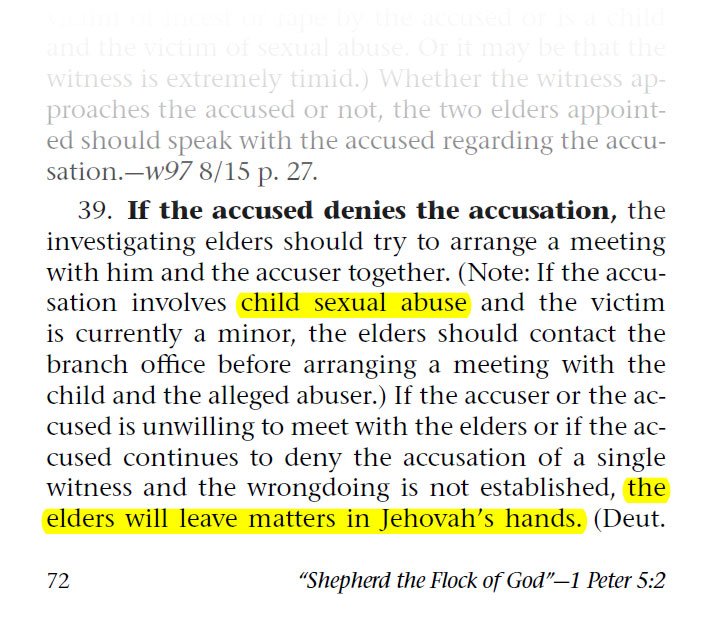 When critics of Jehovah’s Witnesses talk about the organization “protecting” pedophiles, they do not mean that the organization’s literature condones or encourages child molestation. They are referring to the fact that Watchtower policies effectively conceal pedophiles and make it easier for them to operate due to the culture of secrecy and confidentiality that Watchtower insists upon.
In the following video, investigative reporter Trey Bundy explains some of the disturbing lengths Watchtower has gone to in order to keep the identity of child molesters secret.
All of this means that you have no way of knowing whether someone in your congregation is a child molester or not, because the Governing Body is more interested in protecting the reputation of the organization than protecting ordinary children.
All they need to do to change things, and safeguard against more child abuse cases in the future, is write a letter to elders telling them to report ALL accusations of child abuse to the authorities – but the Governing Body absolutely refuses to do this.
If you are a Jehovah’s Witness reading this, you need to ask yourself: How can this be Jehovah’s Organization if it continues to put children at risk despite these adverse court judgments? If Jehovah’s clean organization truly abhors child abuse and considers it a crime, why can’t it allow all accusations of child abuse to be reported in the same way as other crimes (such as theft and murder) are to be reported?
The makers of this web page urge you to consider waking up to the possibility that only by confronting these issues and saying “enough is enough” can we bring about change and safeguard children of Jehovah’s Witnesses from those who would do them unspeakable harm.
We invite you to start doing research using some of the online resources listed below. And please don’t be afraid! Remember that if a God of love and truth really exists, he would never resent someone for trying to uncover the facts.
веб-сайте riobet
зайти на сайт риобет
подробнее здесь riobet
кликните сюда вулкан 777
этот контент вулкан 777
ссылка на сайт вулкан 777
подробнее riobet
можно проверить ЗДЕСЬ вулкан 777
найти это riobet
Hi there, i read your blog from time to time and i own a similar one and i was just curious if you get a lot of spam responses? If so how do you stop it, any plugin or anything you can advise? I get so much lately it’s driving me mad so any support is very much appreciated.
перейдите на этот сайт вулкан 777
посмотреть на этом сайте 1хслотс
в этом разделе 1хслотс
Следующая страница 1хслотс
на этом сайте 1хслотс
найти это https://roxcasino-777.com/
Подробнее riobet
перейдите на этот сайт 1xslots
UTLH combina inversiones, ingresos pasivos y participacion en un programa unico de ayuda mutua. ?? Este enfoque es inspirador. En un ano he ganado mas de lo que esperaba, y ahora estoy seguro de que el token tiene un gran futuro. ??
нажмите, чтобы подробнее риобет
Источник вулкан 777
Astronomers briefly thought Elon Musk’s car was an asteroid. Here’s why that points to a broader problem
skraken
Seven years after SpaceX launched Elon Musk’s cherry red sports car into orbit around our sun, astronomers unwittingly began paying attention to its movements once again.
Observers spotted and correctly identified the vehicle as it started its extraterrestrial excursion in February 2018 — after it had blasted off into space during the Falcon Heavy rocket’s splashy maiden launch. But more recently, the car spawned a high-profile case of mistaken identity as space observers mistook it for an asteroid.
Several observations of the vehicle, gathered by sweeping surveys of the night sky, were inadvertently stashed away in a database meant for miscellaneous and unknown objects, according to the International Astronomical Union’s Minor Planet Center.
An amateur astronomer noticed a string of data points in January that appeared to fit together, describing the orbit of a relatively small object that was swooping between the orbital paths of Earth and Mars.
The citizen scientist assumed the mystery object was an undocumented asteroid and promptly sent his findings to the MPC, which operates at the Harvard Smithsonian Center for Astrophysics in Cambridge, Massachusetts, as a clearinghouse that seeks to catalog all known asteroids, comets and other small celestial bodies. An astronomer there verified the finding.
And thus, the Minor Planet Center logged a new object, asteroid “2018 CN41.”
Within 24 hours, however, the center retracted the designation.
The person who originally flagged the object realized their own error, MPC astronomer Peter Veres told CNN, noticing that they had, in fact, found several uncorrelated observations of Musk’s car. And the center’s systems hadn’t caught the error.
Продолжение вулкан 777
в этом разделе риобет
Читать далее https://roxcasino-777.com
подробнее https://1xslots-casino-ru.xyz
Astronomers briefly thought Elon Musk’s car was an asteroid. Here’s why that points to a broader problem
skraken
Seven years after SpaceX launched Elon Musk’s cherry red sports car into orbit around our sun, astronomers unwittingly began paying attention to its movements once again.
Observers spotted and correctly identified the vehicle as it started its extraterrestrial excursion in February 2018 — after it had blasted off into space during the Falcon Heavy rocket’s splashy maiden launch. But more recently, the car spawned a high-profile case of mistaken identity as space observers mistook it for an asteroid.
Several observations of the vehicle, gathered by sweeping surveys of the night sky, were inadvertently stashed away in a database meant for miscellaneous and unknown objects, according to the International Astronomical Union’s Minor Planet Center.
An amateur astronomer noticed a string of data points in January that appeared to fit together, describing the orbit of a relatively small object that was swooping between the orbital paths of Earth and Mars.
The citizen scientist assumed the mystery object was an undocumented asteroid and promptly sent his findings to the MPC, which operates at the Harvard Smithsonian Center for Astrophysics in Cambridge, Massachusetts, as a clearinghouse that seeks to catalog all known asteroids, comets and other small celestial bodies. An astronomer there verified the finding.
And thus, the Minor Planet Center logged a new object, asteroid “2018 CN41.”
Within 24 hours, however, the center retracted the designation.
The person who originally flagged the object realized their own error, MPC astronomer Peter Veres told CNN, noticing that they had, in fact, found several uncorrelated observations of Musk’s car. And the center’s systems hadn’t caught the error.
Следующая страница 1xslots
Astronomers briefly thought Elon Musk’s car was an asteroid. Here’s why that points to a broader problem
sкракен вход
Seven years after SpaceX launched Elon Musk’s cherry red sports car into orbit around our sun, astronomers unwittingly began paying attention to its movements once again.
Observers spotted and correctly identified the vehicle as it started its extraterrestrial excursion in February 2018 — after it had blasted off into space during the Falcon Heavy rocket’s splashy maiden launch. But more recently, the car spawned a high-profile case of mistaken identity as space observers mistook it for an asteroid.
Several observations of the vehicle, gathered by sweeping surveys of the night sky, were inadvertently stashed away in a database meant for miscellaneous and unknown objects, according to the International Astronomical Union’s Minor Planet Center.
An amateur astronomer noticed a string of data points in January that appeared to fit together, describing the orbit of a relatively small object that was swooping between the orbital paths of Earth and Mars.
The citizen scientist assumed the mystery object was an undocumented asteroid and promptly sent his findings to the MPC, which operates at the Harvard Smithsonian Center for Astrophysics in Cambridge, Massachusetts, as a clearinghouse that seeks to catalog all known asteroids, comets and other small celestial bodies. An astronomer there verified the finding.
And thus, the Minor Planet Center logged a new object, asteroid “2018 CN41.”
Within 24 hours, however, the center retracted the designation.
The person who originally flagged the object realized their own error, MPC astronomer Peter Veres told CNN, noticing that they had, in fact, found several uncorrelated observations of Musk’s car. And the center’s systems hadn’t caught the error.
Astronomers briefly thought Elon Musk’s car was an asteroid. Here’s why that points to a broader problem
skraken тор
Seven years after SpaceX launched Elon Musk’s cherry red sports car into orbit around our sun, astronomers unwittingly began paying attention to its movements once again.
Observers spotted and correctly identified the vehicle as it started its extraterrestrial excursion in February 2018 — after it had blasted off into space during the Falcon Heavy rocket’s splashy maiden launch. But more recently, the car spawned a high-profile case of mistaken identity as space observers mistook it for an asteroid.
Several observations of the vehicle, gathered by sweeping surveys of the night sky, were inadvertently stashed away in a database meant for miscellaneous and unknown objects, according to the International Astronomical Union’s Minor Planet Center.
An amateur astronomer noticed a string of data points in January that appeared to fit together, describing the orbit of a relatively small object that was swooping between the orbital paths of Earth and Mars.
The citizen scientist assumed the mystery object was an undocumented asteroid and promptly sent his findings to the MPC, which operates at the Harvard Smithsonian Center for Astrophysics in Cambridge, Massachusetts, as a clearinghouse that seeks to catalog all known asteroids, comets and other small celestial bodies. An astronomer there verified the finding.
And thus, the Minor Planet Center logged a new object, asteroid “2018 CN41.”
Within 24 hours, however, the center retracted the designation.
The person who originally flagged the object realized their own error, MPC astronomer Peter Veres told CNN, noticing that they had, in fact, found several uncorrelated observations of Musk’s car. And the center’s systems hadn’t caught the error.
Astronomers briefly thought Elon Musk’s car was an asteroid. Here’s why that points to a broader problem
skraken войти
Seven years after SpaceX launched Elon Musk’s cherry red sports car into orbit around our sun, astronomers unwittingly began paying attention to its movements once again.
Observers spotted and correctly identified the vehicle as it started its extraterrestrial excursion in February 2018 — after it had blasted off into space during the Falcon Heavy rocket’s splashy maiden launch. But more recently, the car spawned a high-profile case of mistaken identity as space observers mistook it for an asteroid.
Several observations of the vehicle, gathered by sweeping surveys of the night sky, were inadvertently stashed away in a database meant for miscellaneous and unknown objects, according to the International Astronomical Union’s Minor Planet Center.
An amateur astronomer noticed a string of data points in January that appeared to fit together, describing the orbit of a relatively small object that was swooping between the orbital paths of Earth and Mars.
The citizen scientist assumed the mystery object was an undocumented asteroid and promptly sent his findings to the MPC, which operates at the Harvard Smithsonian Center for Astrophysics in Cambridge, Massachusetts, as a clearinghouse that seeks to catalog all known asteroids, comets and other small celestial bodies. An astronomer there verified the finding.
And thus, the Minor Planet Center logged a new object, asteroid “2018 CN41.”
Within 24 hours, however, the center retracted the designation.
The person who originally flagged the object realized their own error, MPC astronomer Peter Veres told CNN, noticing that they had, in fact, found several uncorrelated observations of Musk’s car. And the center’s systems hadn’t caught the error.
Перейти на сайт вулкан 777
узнать вулкан 777
I have been exploring for a little bit for any high-quality articles or blog posts in this sort of space . Exploring in Yahoo I finally stumbled upon this site. Studying this information So i am glad to convey that I’ve an incredibly just right uncanny feeling I discovered just what I needed. I most surely will make sure to do not put out of your mind this site and give it a glance on a continuing basis.
такой riobet
на этом сайте вулкан 777
продолжить риобет
каталог https://vulkan-777777.ru
перейдите на этот сайт вулкан 777
сюда вулкан 777